September 11, 2017

'Bashert' is Yiddish for: it was meant to be.

In 1960 my father wrote a book about his time in Auschwitz and Buchenwald and of the murder of his parents and most members of his family during the Holocaust.
‘The Yellow Star’ was recently republished after 50 years.
This is the story of how it got to be republished.
It appears as the afterword to the new book.

It’s sad to see how so much of the world seems to have descended into a new epoch of Jew hatred. However much they try to disguise themselves as anti-Israel or anti-Zionist, these are anti-Semites just like the duck analogy walks and talks and looks.

And just as in Germany the Nazis emerged from a highly cultured and educated society, the main sources of this resurgent Jew-hatred are in academia, the arts and cultured classes where anti-Semitic parlour chatter is rife and almost trendy.  Israeli scientists with ground-breaking medical cures are boycotted whilst artists who immortalise Palestinian suicide bombers are lauded and awarded. Most people agree that being supportive of Israel is ‘the kiss of death’ in media and academia; no advancement, no promotion, no prospects.

I am therefore always amazed when any non-Jewish personality actually stands up for Israel. ‘Why do they do it?’ I wonder. ‘What bad dream did this person have that compelled them to risk ridicule and eternal peer-abuse by standing up for the Jewish state?’

Such a question came to me on October 16th 2009 when a British army officer and commander of forces in Ireland, Bosnia and Afghanistan stood up at the UN in Geneva and delivered this speech:

“I am the former commander of the British forces in Afghanistan. I served with NATO and the United Nations; commanded troops in Northern Ireland, Bosnia and Macedonia; and participated in the Gulf War. I spent considerable time in Iraq since the 2003 invasion, and worked on international terrorism for the UK Government’s Joint Intelligence Committee.

Mr. President, based on my knowledge and experience, I can say this: During Operation Cast Lead, the Israeli Defence Forces did more to safeguard the rights of civilians in a combat zone than any other army in the history of warfare.

Israel did so while facing an enemy that deliberately positioned its military capability behind the human shield of the civilian population.
Hamas, like Hizballah, are expert at driving the media agenda. Both will always have people ready to give interviews condemning Israeli forces for war crimes. They are adept at staging and distorting incidents.

The IDF faces a challenge that we British do not have to face to the same extent. It is the automatic, Pavlovian presumption by many in the international media, and international human rights groups, that the IDF are in the wrong, that they are abusing human rights.

The truth is that the IDF took extraordinary measures to give Gaza civilians notice of targeted areas, dropping over 2 million leaflets, and making over 100,000 phone calls. Many missions that could have taken out Hamas military capability were aborted to prevent civilian casualties. During the conflict, the IDF allowed huge amounts of humanitarian aid into Gaza. To deliver aid virtually into your enemy's hands is, to the military tactician, normally quite unthinkable. But the IDF took on those risks.

Despite all of this, of course innocent civilians were killed. War is chaos and full of mistakes. There have been mistakes by the British, American and other forces in Afghanistan and in Iraq, many of which can be put down to human error. But mistakes are not war crimes.

More than anything, the civilian casualties were a consequence of Hamas’ way of fighting. Hamas deliberately tried to sacrifice its own own civilians.

Mr. President, Israel had no choice apart from defending its people, to stop Hamas from attacking them with rockets.

And I say this again: the IDF did more to safeguard the rights of civilians in a combat zone than any other army in the history of warfare.

Thank you, Mr. President.”

I was brimming with admiration, but yet still wondering: why?

I got the answer two years later on a plane out of Tel Aviv where I spotted the officer, Colonel Richard Kemp, in the opposite aisle seat. 
I said I wanted to shake his hand and thank him for his courageous defence of my people. We exchanged cards and deplaned in London.

Later that evening I got the following email from him : 

“Many years ago I read a book called The Yellow Star by somebody who was I believe called S B Unsdorfer. Any relation?”  

I replied: “Wow .. what a coincidence. That was my father's book. Long out of print.”

He replied: “A remarkable coincidence. I never expected to have the honour to meet the author of The Yellow Star, or indeed his son. I read the book when I was about 14 or 15. A phenomenal work. Without question, of the many books I have read in my life, your father's made by far the greatest impression on me. I read a battered paperback copy that belonged to my aunt, and I still have it.”

Well – this time I got my answer to my eternal question about what makes such a person speak out for Israel.

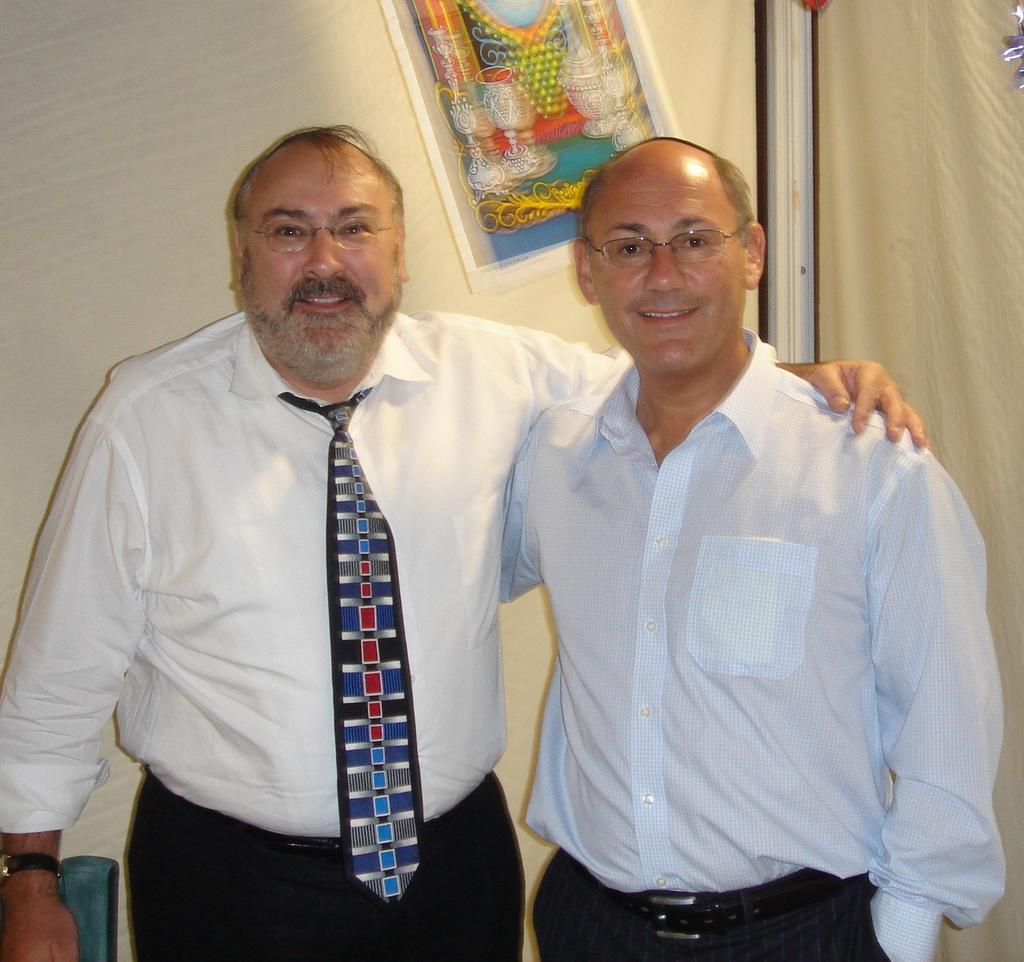
I decided there and then to republish and digitize The Yellow Star with thanks to Richard for his inspiration and for agreeing to write a personal foreword.


We are now good friends and I continue to follow Richard's outstanding advocacy for Israel and her armed forces in forums all over the world, and his support of all those brave souls, in and out of uniform, who are fighting the just war against radical Islamist terrorism and the forces of jihad.


The Yellow Star is available at Amazon and other online vendors.

See Richard Kemp's blog here.
Watch his UN speech here. 

Labels: , , , , , , ,

January 27, 2015

Auschwitz - to visit is to defy the evil

As I watch scenes from Auschwitz on this 70th anniversary of its liberation, I remember my own visit 11 years ago for the memorable IAF flypast. 

It coincided with a bitter time in Israel when the Cafe Hillel bombing took the life of a young bride and her father the night before her wedding in Jerusalem. 

This is the memoir I wrote at the time for the American Jewish Press ....

FLIGHT OUT OF DENIAL


Labels: , ,

July 13, 2012

Bureacracy of the Devil

I may have blogged this in the past, but it is compelling viewing.

Click on the picture or at this LINK.

Labels: , , , ,

October 20, 2005

Pushed into Survival


My father's Auschwitz nightmare began on a chilly October morning in 1944. At the tender age of 19 he watched his parents selected for death on the infamous platform at Birkenau, their parting blessings drowned out by the barking of crazed Alsatian dogs straining on the leashes of their jackbooted minders. The SS were determined to weed out any old or weak specimens unable to assist in Hitler's war effort. So, a further ‘selection’ was carried out in the barrack into which my father was marched along with the surviving members of that morning's cattle-truck shipment from his home town of Bratislava.

The barrack was bisected along its length by a horizontal brick-clad flue that ran along the floor from the stove at one end to the rising chimney at the far end. The inmates were ordered to line up on either side of the brick platform, on which the infamous 'camp doctor' Josef Mengele stood in judgement; who shall live and who shall die.
Now my father was not the healthiest looking specimen, with a pale and skinny physique and glasses that seemed bigger than his face. Far fitter types were being rejected as they shuffled in parallel files under Mengele’s thumb, gesturing alternately on either side of the platform.

And then, just as my father passed under Mengele’s arm, he was pushed from behind with a powerful shove. It sent him stumbling into the line in front and he scrambled to regain his footing. In that split second, as Mengele turned to my father’s line, he looked quizzically at the melée and continued his selection.

When the process was completed, Mengele let out a loud scream. “Etwas ist loess”, (something is wrong!). "Voh ist der mit die brillen???” (Where is the guy in the glasses?). Not to be cheated of the life of a single Jew, he called the whole group back to repeat the selection. However, by this time, my father’s comrades had told him to dump the glasses and switch berets with them to avoid recognition by the so-called Angel of Death.

And so my father was to survive the second selection and, ultimately, the Holocaust.

Two years ago I stood in such a barrack as a visitor to Auschwitz-Birkenau.

I had come to witness the flypast of Israeli F-16s over the infamous railhead. And a week after returning home to England, I could not concentrate on my work. My wife suggested I clear my head by putting my thoughts and feelings down on paper. I did so, and the resulting
story was published on the front page of the Jewish Press in New York.I got many emails in response to that article. One was from a man named Fishof, with a stunning message. “My father was the man who pushed your father in that line.”

Last night I met David Fishof for the first time in his Succah in Jerusalem. This October month was a lot warmer in Israel than it was in Poland exactly 61 years before. And the sons of two Holocaust survivors were drinking a Lechayim as free Jewish men in the eternal capital city of their nation.

It is a story of Netzach Yisrael – the eternity of the Jewish people - who continue to grow and flourish whilst those who sought to destroy us have long perished.

Labels: , ,

September 24, 2003

Flight Out Of Denial


The Nazis finally caught up with my father in 1967. I was only sixteen years old when he succumbed to the heart disease contracted through an untreated infection in the concentration camp. At roughly the same age, in 1944, my father had been thrust into the hell of Auschwitz and seen his parents selected for death at the notorious railhead at Birkenau.

As a teenager, I had heard about and read almost all
the stories and articles about my father`s time in the camps and was intimately familiar with his book, The Yellow Star. He turned to writing partly as a therapy for the early nightmares but mainly to make sure that the world and future generations would know what happened.
With the loss of my father, I felt that this monster that was the Shoah had lashed out in its death throes to bag an unclaimed victim 22 years after everyone thought it was
safe. I decided to switch off the whole subject in my mind,
and have spent most of my adult life in a state of denial.
As opposed to the loathsome Holocaust deniers, for
me this was just a safety mechanism by which I shunned
all the films and documentaries, never visited Yad Vashem
and did not see “Schindler`s List.” I even avoided traveling
to many European cities because many of their streets still
looked the same as they did in those gaunt black-and-
white photographs of the roundups.
All that changed when I opened a newspaper last
month and read that the Israeli Air Force had sent three of
its F-15 fighter jets to participate in the 85th anniversary
celebrations of the Polish Air Force. Like me, the Israeli
base commander had lost grandparents in Auschwitz, but
he also had a burning ambition. For 15 years Brigadier
General Amir Eshel dreamed of flying the most lethal of
Israel`s jet fighters over Auschwitz as a powerful symbol of
remembrance and defiance. The paper reported that, after
some hesitation, the Polish authorities gave their
permission and a date was selected -- September 4, the day
the F-15s would make their 1,600-mile return flight to
Israel.
The thought of such an event totally captured my
imagination and I decided, there and then, that I must be
there for this unique spectacle. No one was more surprised
than my wife. After 20 years of marriage to a Europhobe,
she found me downloading web pages about Auschwitz. I
instinctively felt that this was going to be my best chance
to reconnect with my father`s memories and establish some
emotional and spiritual connection with the grandparents
I never knew.
In an effort to retrace his footsteps, I dusted off my
father`s book to re-read on the flight. The manner of our
arrival in Poland could not have been different. He and his
parents in a stifling cattle truck, me in a Boeing 737. I
spent the night in a delightful guesthouse in Cracow`s
Jewish quarter, he in a railway siding. That evening I fell
asleep reading about how, on the first night of Chanukah
in the camp, my father had lighted a home-made wick in
an old shoe-polish tin filled with engine oil. That simple
contraption had done more to lift the spirits of the inmates
than anything else up to the day of liberation.
The following morning, as I sped through the heavily
wooded countryside, the weather seemed to deteriorate
with every mile. My driver doubted whether any flight
would be attempted through clouds that still clung to the
treetops. He wondered how upset I would be, having made
the trip especially for the flypast. Strangely I was not that
bothered. I thought about the Dayenu song we sing on
seder night: `If I had been able to come to this place as a
free Jew and not seen the flypast ... dayenu ... it would be
enough for me.
*******************
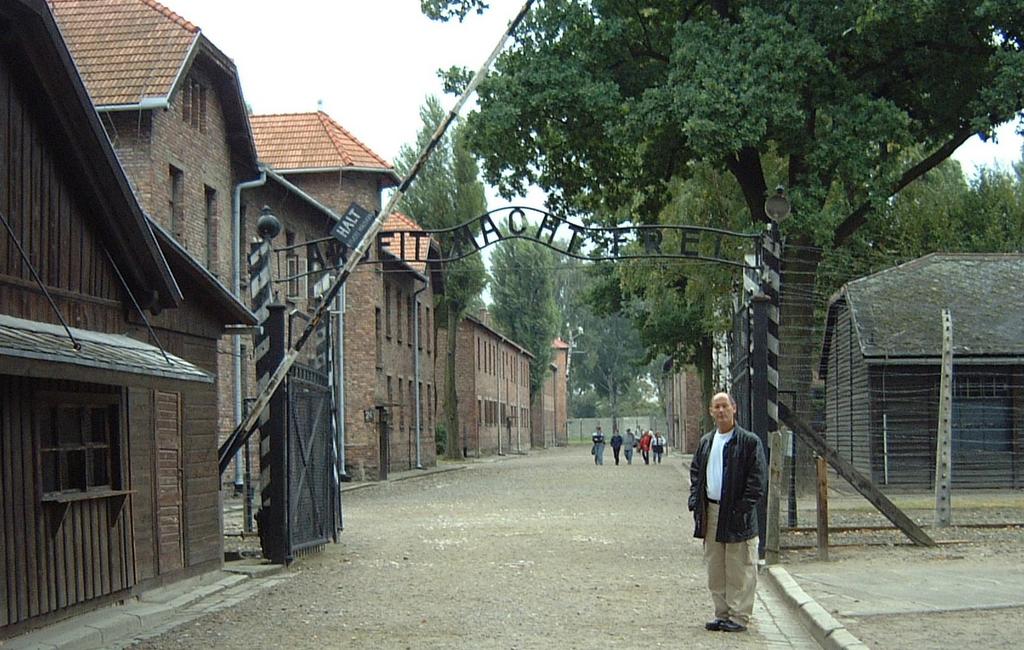
On arrival at Auschwitz, my guide took me through
those infamous gates that bear the words ``Arbeit Macht
Frei `` (work sets you free). He explained that Auschwitz is
made up of three camps, this smaller section having been
turned into a museum. The largest -- by a factor of 10 -- is
Birkenau, a few kilometers up the road. It was there that
the selections and mass killings were carried out and over
which the flypast was due to take place at noon.
Many of the brick barracks of Auschwitz One have
been turned into exhibit halls in which the grisly contents
of the display cabinets are every bit as harrowing as the
photographs on the walls. Of the thousands of victims`
shoes, I only noticed the children`s sizes and amongst the
bales of human hair I was transfixed on the little plaits
and pigtails. Walking through these halls, struggling to
keep my composure, I passed small tourist groups
clustered around their guides. I noticed many were staring
at me. I seemed to be the only one there wearing a kippa.
There were backward glances from Chinese eyes and
Latino eyes, Indian eyes and Pakistani eyes -- many of
which, I felt sure, had never seen an Orthodox Jew in the
flesh.
I was preoccupied with those glances when I came
upon two small display cabinets and saw in them
something totally unexpected. I thought of my father
hiding that solitary Chanukah candle under his bunk and
felt the tears well up. I rushed toward the nearest window
and cried. My guide could not understand why, after the
shoes, the hair, the suitcases and the glasses, I should be
so affected by a simple collection of old shoe-polish tins.
By the time we were ready to move on to Auschwitz
Two, I had seen my fill of neatly spaced barracks that had
been used for all manner of cruelty and experimentation as
well as the jailhouse and its adjoining yard that had been
used for executions by firing squad. Wooden watchtowers
strung together by electrified fences surrounded all of this
orderly abomination.
The rain had stopped by the time we arrived at
Auschwitz Two -- Birkenau. The sky was still a forbidding
deep grey, matching the feel of this sprawling campus of
death. I stood under the arch through which the cattle
train bore my father and his parents into this hellish place
on a chilly October morning in 1944. I later realized that I
had been standing there at 11 a.m., the same arrival time
recorded in my father`s book. With my guide, I climbed the
stairs to the main watchtower above the arch. Strung out
before me was the deserted railway track. Halfway down
its quarter-mile length it forked to form the infamous
central ramp on which Hitler`s SS carried out their
murderous selections.

On either side of the track there were endless ranks of
chimneys standing like sentries, each within a rectangular
brick outline, evidencing where barracks once stood. My
guide explained how the retreating Germans had blown up
most of Birkenau in an effort to hide evidence of their
murderous work. Far in the distance, at the end of the
railhead I pointed to a splash of blue. ``It`s the Israelis,``
said my guide. Up to that point I had not realized they had
planned any official gathering. Alienated by the stares in
the museum halls and the specter of this place, I warmed
at the thought of joining some of my own people. We
descended the watchtower steps and started our trek down
the line.
Along with most of the barracks, the gas chambers
and crematoria of Birkenau had been dynamited and left
in ruins. Fortunately the SS were not able to silence
survivors like my father who would later tell the world
what these ruins once were. Just to the left of the selection
ramp, I was shown the ruins of a gas chamber in which it
is almost certain my grandparents were put to death on
the day of their arrival. I had brought two memorial
candles from home and lit them in a niche between the
fallen brickwork. Although I had never known them, the
kaddish I recited for my grandparents was long, halting
and tearful.
Trudging farther down the rail track, I could see the
blue-clad ranks of IAF officers and cadets standing to
attention at the end of the line. Alienated by all that I had
seen so far, I was overcome with emotion at the sight of
that bright blue Star of David fluttering against this awful
grey landscape. All I wanted to do right then was rub my
cheek against that flag.

Holding a small sefer Torah, the chaplain was reciting
Tehillim. As the cantor recited the hazkarah (memorial
prayer) I saw that rows of memorial candles had been
placed on the rusted rails at the head of the track. I stared
fixedly at their flickering lights as the kaddish was recited.
The Israeli ambassador spoke movingly of the powerful
message being brought to Auschwitz today. He said it was
for Yankeleh and Moisheleh, for Soroleh and Rivkeleh and
so many of the little children who might now have been
proud citizens of Israel.
In the stillness of the next few moments, three black
specks appeared in the sky above the main watchtower in
which I had stood minutes before. A man-made thunder
echoed from all corners of the camp as the F-15s raced
towards us in an arrow formation. As they streaked
overhead, a loudspeaker on the ground crackled into life
and Commander Eshel spoke from the lead jet:
“We pilots of the air force, flying in the skies above
the camp of horrors, arose from the ashes of the millions of
victims and shoulder their silent cries; we salute their
courage and promise to be the shield of the Jewish people
and its nation: Israel.”
There was hardly a dry eye in our gathering as the
three jets banked across the sky for a return pass. The
rolling thunder of jet engines echoing above the heavy
blanket of cloud made it feel like an almighty fist was
being shaken in the heavens. As the fighters returned I
thought of Commander Eshel and those like him who are
now the guardians of our nation. I recalled the words of
Menachem Begin in the introduction to his book The
Revolt:
“... I have written this book also for Gentiles,” Begin
wrote, “lest they be unwilling to realize, or all too ready to
overlook, the fact that out of blood and fire and tears and
ashes a new specimen of human being was born, a
specimen completely unknown to the world for over
eighteen hundred years: ‘the Fighting Jew.’ ”
I thought to myself: Commander Eshel, you are one of
that new breed and we are immensely proud of you.
***************************
On the flight home, I re-read some of the chapters of
my father`s book, now that I felt familiar with some of the
settings he had described. I came across the part where my
grandfather, the much-loved Rabbi of Pressburg, had tried
to pacify some of the passengers in the cattle wagon
heading for Poland. He swore to them that everything
would be all right: ``I swear on my place in olam habah --
the world to come -- that we will survive this.`` My father
recorded his surprise that, even for such short-lived
comfort to others, a rabbi might swear falsely.
I now realize that my grandfather was right after all.
“We” -- meaning the Jewish nation -- did survive. Boy, did
we survive!
From the edge of genocide, we have come back to
build our own state with arguably the most feared army
and air force in the world. Without oil, gas or any natural
resources other than brains and determination we have
built cities, highways, skyscrapers, airports and seaports.
And with those brains we have a higher ratio of
university degrees, and annually produce more patents
and scientific papers per capita than any other country in
the world. Even in these troubled times, Israel is ranked
number two in the world for venture capital funds, right
behind the United States. And its $100 billion economy is
larger than all its oil-rich neighbors combined. The world`s
computers run on the chips we designed and are protected
by the anti-virus systems our people have invented. We
pioneered the cellular phone, voice mail and instant
messaging. One in four prescriptions filled in the United
States is for a medication made in Israel. Not least, we are
a responsible nuclear power and have already launched
our own satellites into space.
All this, in a 55-year-old speck of a country that in
some places is only eight miles wide.
Any non-believers still out there?

**************
I finish my story in our eternal city of Jerusalem. A
city of such beauty and wonder, not even the darkest
shadow of terror can have domain for longer than an hour
or two. That is the time it takes to clear a scene of carnage
so that it appears never to have happened.

As I drive by the shuttered frontage of the latest
bombing, I see it is aglow with the light of a hundred
flickering memorial candles. I still have fresh memories of
similar candle glasses perched on those rails at Birkenau
and I realize that, even after 60 years and in our very own
capital city, we are still not free of our pursuers.
My father lived just long enough to see Jerusalem
liberated in 1967 but, much as he had dreamed of it, he
never had the chance to pray at the Western Wall. I think
of him every time I go there, knowing he would be proud
that my two eldest sons are learning in local yeshivas.
On Friday night, I have the choice of countless
synagogues in this area of Jerusalem but, whenever I am
here, my preference is Breslov. It is a shul that attracts all
types, from chassidim to hippies; a place where the “Lecha
Dodi” is a half-hour celebration of singing and dancing.
I looked around the place as this unlikely mix of Jews
sang and clapped their rousing welcome to the Sabbath
Queen. I realized that most of these locals lived within
earshot of the latest bombing and many must have been
deeply affected by it. But you would never know it. Those
faces were as joyous and happy as if, despite the terror and
the recession, they had not a care in the world.
It came home to me that, for our people, Shabbos is a
process of weekly renewal that cleanses us just as surely
and efficiently as those volunteers who clear the sidewalks
of any vestige of terror and tragedy.
Only a nation capable of such renewal could possibly
have risen from the ashes of the Holocaust, let alone
reached such world-beating heights. Such a nation -- our
Jewish nation -- will surely overcome any obstacle and
every challenge placed in its path.
_________________________________________________
[This article first appeared as a front page essay in the Jewish Press]
To see video of the flypast, click on the first picture.
The author's pictures of the visit may be viewed here.

Labels: ,

Add to Technorati Favorites Tweets by @ZalmiU