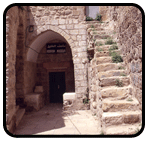
The time was early in the 17th century. Jewish Hebron had been among the hardest hit by a plague that killed hundreds of people throughout the land of Israel. People fled the cities for the desert, for small villages, anywhere to escape the deadly plague. Only a few Jews had remained in Hebron on this particular Yom Kippur Eve.
The Jewish Quarter had originally been purchased by Spanish exiles and, in its small domed synagogue, nine men stood ready to begin Kol Nidrei, the start of the Yom Kippur liturgy. But where was the tenth man, the worshiper who would complete the minyan, the quorum necessary to pray? The cantor began his supplication to the Heavenly Assembly which is repeated three times. As he began the third call to the ‘Yeshiva shel Maalah’ the door opened and an old man walked in wearing the traditional kittel shroud and tallit. There was a collective sigh of relief that the service could now continue.
When the evening service was finished, the stranger insisted on staying in the synagogue overnight. The next day he was honored to be called up third to the Torah reading. As the holy day wound to a close, the congregants competed for the privilege of inviting their guest to break his fast in their home. As a compromise it was agreed that the cantor should have that honor.
Walking through the narrow alleys of the Jewish quarter, the old man was slow in following. At one turning, the cantor lost sight of him. “He must be resting,” the cantor thought and retraced his steps. To his dismay, the old man was nowhere to be found. After searching for an hour, he returned home exhausted and told his wife: "I cannot find our honored visitor, the tenth of our minyan. The poor soul must be lost and starving." After breaking his fast the cantor retired to bed, still distressed over his missing guest. During the night, the old man appeared to him in a dream. "Dear host, cherished resident of Hebron, please do not be upset. I am not lost and I have no need to eat or drink. I was sent by the Heavenly Assembly to be with you on Yom Kippur so that you should have a minyan. For I am your father Avraham.”
400 years later, standing in what has ever since been called the Avraham Avinu Synagogue, I listened to this story as a guest of the new settlers of Jewish Hebron and as part of a solidarity visit to the communities of Judea and Samaria. Like the majority of Diaspora Jews, I have often viewed our settlers as religious gun-toting fanatics who are an obstacle to peace in the Middle East. However, I was willing to be persuaded otherwise and accepted an invitation to join a two-day visit to Judea and Samaria. The first thing to understand is that Judea and Samaria - commonly referred to as the West Bank – comprises biblical Israel and much of the original Jewish homeland. Whilst Abraham never visited Tel Aviv, Hebron was his first stop in the land that was promised to our people. Genesis carefully records his purchase of the Tomb of the Patriarchs – Machpela and its surrounding field - for 400 silver shekels. It was in Hebron that King David was anointed and where he reigned for seven years.

The story of our people’s return to Machpela after 700 years was best told by Rabbi Shlomo Goren, Chief Rabbi of the Israel Defence Forces during the 1967 war. Fresh from the liberation of Jerusalem and the Western Wall, he wanted to be among the first Jews to return to the ancient city of the patriarchs. Holding the rank of general, he joined the armed forces stationed at the recently captured Etzion Bloc, on their way to Hebron. On the evening of 28 Iyar, before retiring for the night, he asked to be wakened when the soldiers began their march into Hebron the following day. The next morning he awoke, only to find himself alone with his driver. Realizing that he had been left behind, he ordered his driver to begin the 20-minute journey into Hebron, expecting to meet the rest of the army enroute. Rabbi Goren thought it peculiar that he hadn’t encountered any Israeli soldiers on the road and assumed that they had already secured the city in record time. Driving into Hebron, he was greeted by the sight of white sheets fluttering from the windows and rooftops of Arab homes. The Rabbi theorised that this must be fear of retaliation for their 1929 pogrom in which 67 Jews were massacred and many more wounded. Leaving his driver and clutching a Torah scroll, Rabbi Goren quickly made his way toward the Herodian walls which now surround Machpela; the Tomb of the Patriarchs. Once inside he blew the Shofar, just as he had done 24-hours earlier at the Western Wall. Only afterwards did he discover that when he left the Etzion base, the rest of the forces were on the other side of the hill, making plans for the attack on Hebron. The army was astonished to find that their Chief Rabbi had single-handedly conquered a city of 80,000 Arabs. Jews had finally returned to Hebron and the sacred burial place of their patriarchs!
There were fifteen in our group, mainly businessmen from London and New York, plus an armed guard and tour guide. Our first day was to cover Samaria, to the north of Jerusalem, starting out in the territory of the tribe of Benjamin.
 Successive prime ministers of Israel have always been careful to locate settlements in high places. One of those strategic heights is home to the 1,500 religious settlers of Psagot, which boasts an outstanding view of the Arab town of Ramallah. This is a picture of Ramallah you will never see on the BBC or CNN. On all sides there are modern apartment buildings and villas capped with red tiles. But right in the centre of this colourful townscape - like a cancer embedded in healthy pink flesh - lies the dark grey smudge of the refugee camp. Managed and preserved by the oil sheikhs of Arabia, this ugly trophy of the Palestinian struggle is always very carefully cut, cropped and pasted into the world’s media.
Moving north into the tribal territory of Ephraim, we came upon the settlement of Shilo. You can find it easily by following the directions contained in the Book of Judges (21:19). North of Bet El, east of the road heading from Bet El to Shechem and south of Levona. It was here that the Tabernacle - Mishkan - stood for 369 years. It is where Hannah prayed for a child and where that child, the Prophet Samuel, first heard the word of G-d.
Whilst we felt reassured in our bulletproof bus, there was no time during our various stops that we felt in any real danger; at least no more so than in Jerusalem. We learned however that many of the smaller settlements had been set up as acts of defiance following the murder of Jewish civilians. Rachela Druck was killed in a bus attack on the main road from Jerusalem to Shechem. After the funeral, women from nearby settlements gathered together and determined that a new settlement – Rachelim - should rise at the exact site of her murder. This was to be my first inkling of the formidable power of women in the settlement movement. Within an hour I was sitting in the office of the feisty Daniella Weiss, mayor of Kedumim. This is a 4,000-strong religious settlement rooted in commanding hilltops overlooking Shechem (Nablus). Reminiscent of Golda Meir in her prime, Weiss was part of the original Gush Emunim movement which succeeded after eight attempts to re-establish the Samarian capital that King Herod built as Sebastia.
 One of the nearby hilltops is Gerizim - Mount of the Blessing. This is where Joshua brought the Jewish people on entering Eretz Israel. From here we had a bird’s-eye view of the sprawling city of Nablus. Not as picturesque as our unblinkered view of Ramallah, this place has trouble written all over it. It also has something we want: the tomb of our patriarch Joseph. It was with great sadness that I looked down at this site, feeling that Joseph had once again been abandoned by his brothers.
In Hebron the following day, I found more evidence of the power of women in the settlement movement. Sarah Nachshon had been one of the first Jews to move into the new settlement of Kiryat Arba with her husband Baruch and they were soon blessed with the birth of a son. Privileged to have his brit performed in the Cave of Machpela, they named the boy Avraham. Tragically the baby fell victim to crib death at 3 months. In a grieving search for some purpose in this terrible blow, Sarah determined that, having been brought into the covenant of Abraham in the Cave of the Patriarchs, her son should be buried in Hebron’s ancient cemetery. But Hebron’s cemetery was not in Jewish hands. Closed by the British after the 1929 pogrom, it had been locked up and off-limits for 45 years. This did not deter Sarah Nachshon. Holding her lifeless baby, she led a procession of Kiryat Arba residents, past the Cave of Machpela and the Avraham Avinu synagogue, toward a confrontation with the Israeli border guards. Senior officers barked orders over walkie-talkies: “You will obey your command and must not let them pass!” The sentries, overcome by the scene replied: “The mother is standing here with the baby’s body in her arms. If you are able to stand in her way, please come down here and do it yourself.”
Only moonlight illuminated the burial field as the tiny bundle was lowered into a fresh grave, dug just a few meters from the mass grave of 1929’s pogrom victims. Then Sarah Nachshon spoke. “Four thousand years ago our patriarch Abraham purchased Hebron for the Jewish people by burying his wife Sarah here. Tonight Sarah is repurchasing Hebron for the Jewish people by burying her son Avraham here.” Hebron’s cemetery has been open to Jews ever since and is now fully restored with proper markers for the victims of the 1929 massacre.
 Another part of Hebron liberated by women is Beit Hadassa, the old Jewish hospital in the Avraham Avinu neighborhood.. This also fell victim to the 1929 riots during which local Arabs murdered the very doctors who had cared for them. Fifty years later, just after Pesach 1979, a group of 10 women and 40 children left Kiryat Arba in the middle of the night and somehow crawled into the basement of the abandoned building. They swept up decades of dust from the floor, laid down mattresses and went to sleep. The following morning, IDF soldiers were astonished to hear the sound of children singing. After much government wrangling, food and supplies were allowed in. Later, occupants were allowed to leave and return, but no one else was allowed to join them. The women and children lived this way for a year. On Friday nights, after prayers at Machpela, husbands would stop at the gates of Beit Hadassa to recite Kiddush for the women. One Shabbat they were fired on by Arab gunmen who killed 6 men and left 20 wounded. Within days the Begin government responded by granting official permission for the reopening of a Jewish community in Hebron. In the continuing process of defiance over death and tragedy, the names of the dead have been immortalised on a new apartment building called Beit Hashisha (House of the Six), which is now home to new Hebron families.
 The last stop on our tour was Rachel’s Tomb, which I had not visited since the 60’s. The privilege that we are still able to pray at Judaism’s third most important site is solely due to determined resistance to its surrender to the PA under the infamous Oslo Accords. Once again, women have figured prominently in this resistance, defying soldiers to open the way for them to enter the tomb on the anniversary of Rachel’s death. Whilst persistent Arab rioting has changed the exterior into a watchtowered fortress, the interior remains a timeless sanctuary of prayers and tears. At the entrance to the men’s section there is an ark draped with the blue velvet curtain salvaged from Joseph’s Tomb. It still bears the bloodstains of the valiant soldier left to die of his wounds when the IDF abandoned the site to Arab rioters. The ladies’ section is screened off by a white curtain of satin and lace. The inscription reads that this is the unworn bridal gown of Na’ava Applebaum, killed alongside her father the night before her wedding.
I remember passing that bombed-out frontage of Café Hillel, lit with the glow of a thousand memorial lights, and my feelings of utter despair at the violent loss of an innocent bride and such a gifted father. But after two days in the territories I have come to realise that in this land of wonders, new life is somehow distilled from every death and fresh resolve squeezed from every setback. Seemingly oblivious to the terrorist threats and financial hardships that line heavy brows in Tel Aviv and Haifa, the religious settlers seem to have a sunnier and more optimistic outlook. Their eyes are filled with excitement like newly married couples starting out in their first home. They are reclaiming and rebuilding the ancient Land of Israel. For them, Judea and Samaria is a field of dreams stretching back two millennia. They have confidence that … if they build it, He will come.
___________________________________________________________________
This essay first appeared as a front page feature in the American Jewish Press
Labels: settlers, west bank